Why do hard shell suitcases break? Importers' Guide for a Manufacturer
Many travelers consider a cracked suitcase one of the most frustrating luggage problems out there. When the shell cracks, customers can tell immediately that the product is no longer trustworthy, even if the suitcase still rolls and the handle still works.
Cracked hardside luggage is more than a product issue, for importers." This can lead to negative reviews, return requests, warranty claims and distributor complaints. That is why the durability of shell should be one of the most important checks when buying hardside luggage.
We, a manufacturer of hard-side luggage, often face one big misconception: that suitcase cracking is caused by material alone. It is usually related to the choice of materials, thickness of shell, structure of corners, strength of base of wheel, method of packing, size of product and quality inspection.
Why are hardside suitcases cracking? What importers should look for before placing bulk orders.
Why Customers Are Concerned About Cracked Hardside Luggage
Customers who want their belongings protected and a more structured look than softside luggage choose hardside luggage. If the shell cracks, they may feel that the suitcase has failed its most fundamental function.
Typical customer concerns are:
"Will the suitcase get broken after being checked in?"
How durable is ABS luggage?"
" Is the impact resistance improved by PP?"
"Why did the corner break first?"
"Is the crack in the suitcase still usable?"
"Does the airline cover damaged luggage?"
These are common questions because travelers don't always understand the construction behind hard-shell luggage. All they see is the last problem: the suitcase shell is broken.
For importers, that means product pages should not just say "durable hardside luggage." They need to explain the material, structure, testing and after-sales support behind the product.
1. Material Selection: Do not mix ABS, ABS+PC and PP in one message
Material is the first thing many buyers ask about, but it should be explained carefully.
We can produce hardside luggage with ABS, ABS+PC and PP materials. Each material has its own product positioning and selling points, so these materials cannot be described in the same way.
Hard Side ABS Luggage
ABS is a common material for cheap hard-sided luggage. It is suitable for buyers requiring competitive pricing, wide color choices and mass market luggage products.
For price-sensitive channels, promotional products and entry-level retail lines, ABS can be a practical choice for importers. However, the ultimate durability still depends on the product structure, shell design, corner strength and testing process.
ABS+PC hard shell case.
ABS+PC is usually the choice for buyers looking for a more balanced hardside luggage solution. It can be placed at higher perceived quality than basic entry level models especially for e-commerce, retail and private label projects.
In the case of importing ABS+PC, it is necessary to clarify the product structure, size, weight and test requirements prior to production.
PP Hard Side Suitcase
Another type of hardside luggage is PP. For buyers who want a different material direction than ABS or ABS+PC, PP can be discussed with the manufacturer according to the target market, price range and product design.
The important point is that importers should use one general description for all materials. ABS luggage, ABS+PC luggage and PP luggage product page should have different wording.
Importer Tips
Before writing product descriptions or placing bulk orders, check with the supplier on the correct shell material. Don't simply state "premium PC luggage" if the product is ABS, ABS+PC or PP.
2. Cracks Often Start from Stress Points, Not the Middle of the Shell
Many customers believe that the suitcase cracks in the middle of the shell. In fact, cracks tend to form around the stress points.
Typical stress points are:
Corners
Region of wheelbase
connection area handle
Edges of side
Connection area for zipper or frame
Decorative enclosure or faceplate
Areas subject to repeated impact
During actual travel these areas get more pressure. A suitcase can be dragged, lifted, dropped, stacked, pushed or compressed in transport. Weak stress points may crack first.
For importers this means that the durability of the shell should not only be judged by touching the surface. Check the corner design, wheel base, handle fixing points and internal reinforcement.
3. Shell cracks are often mistaken for wheelbase cracks.
Cracking around the wheel base is one of the most common problems in hardside luggage.
The customer might say "the suitcase cracked" but the actual problem might be the wheel housing or the area around the corner. This is because wheels are always under stress from rolling, turning, pulling and impact.
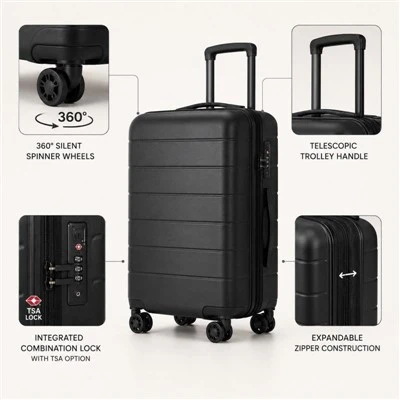
A suitcase with 360° spinner wheels should be able to go in different directions. If the wheel base is not strong enough, it can be a weak point in the surrounding shell area.
This is important for importers, because you need to judge the quality of the wheel and the strength of the shell together.
A sturdy suitcase must have:
Stable Wheel Cover
Sturdy wheel mounting structure
Secure corner support
Smooth spinner wheel 360° move
Good Wheel Test Results
No visible slack after rolling.
We can make our hardside luggage with 360° spinner wheels and quiet wheels design. Quality control can involve wheel testing, drop testing and trolley testing before shipping.
4. Cracking Risk Depends on Product Size, Load
The same shell structure can work differently for different suitcase sizes.
Our standard hardside luggage comes in three sizes, 20 inch, 24 inch and 28 inch. The net weight is approx. 2.8 kg, 3.5 kg and 4.5 kg depending on size and configuration.
A 20-inch carry-on suitcase is usually for short trips and lighter packing. A 28 inch checked suitcase can hold more items and take more pressure during transit.
This means importers should not just sign off on one size and assume all sizes will perform the same. Size should be checked according to its intended use.
Importer's Tip
For three-piece luggage sets, look at each size individually for its construction. Special attention should be paid to the 28 inch suitcase as it usually carries more weight and is more likely to be checked in during flights.
5. Expandable Zipper Design Affects Structure
Expandable luggage is loved by customers for the extra packing space it provides. We can make our hardside luggage with expandable zippers.
But importers have to be careful with the design of the expandable structure. If the suitcase is expanded and packed full, pressure can be applied to the shell and zipper area.
Does this mean expandable luggage is not durable? This implies that the product needs to be properly designed and tested.
For importers, the questions are:
The expandable zipper is very stable.
Does the big suitcase keep its shape?
Does it bulge out too much when packed full?
Is the area around the zipper well supported?
Is the suitcase load tested?
The market for a good expandable hardside suitcase can be practical, but buyers should not forget the structure when they are concerned with the capacity.
6. Specific corners attention
One of the most critical areas in hardside luggage design is the corner.
While travelling, they are liable to collide with the ground, stairs, car trunks, conveyor belts and other luggage. If the corner area is too weak, cracks could occur earlier than expected.
When inspecting samples, importers should inspect:
Thickness at corner
Shape of Corner
Wheelbase connection
Edge strength of the shell
Whether the white stressed or deformed corner after impact
Has the drop test been conducted or not
The suitcase does not only have to look strong when it is new. It should also hold its shape after realistic handling.
7. Testing is Key – Don't Just Look at It
A suitcase does not need to be durable just because it has a glossy shell, a fashionable colour or a premium-looking design.
The most practical way to minimize risk for importers is to test before ordering in bulk.
Our quality control may include:
Inspection of the factory
Drop Test
Wheel test
Testing trolley handle
The tests are intended to test the suitcase's ability to withstand the normal rigors of travel.
Drop Test
Drop tests are performed to see how the suitcase behaves on impact. Importers should pay attention to the corners, wheel areas and shell edges after the test.
Wheel Tests
Wheel testing is important as wheel base cracks are a common source of customer complaints. The wheel must turn smoothly and the wheel housing must stay steady.
Testing the Trolley Handle -
The shell structure is connected to the trolley handle. If the handle area is weak, it can affect the overall product experience. We can make our luggage with iron or aluminum trolley handles Three section trolley handle can be used for making 20 inch luggage. Two section trolley handles can be used for making 24 inch and 28 inch luggage.
Inspection of the Factory
Factory inspection can help check the product appearance, structure, parts and the basic quality before shipment. For B2B buyers it's a key step in reducing risk after sales.
8. Cracking is also related to market positioning.
Every suitcase is not meant for the same customer or channel.
The suitcase for low-price promotion, the suitcase for business travel and the suitcase for fashion retail should not be evaluated in exactly the same way.
Our hard side luggage can accommodate the needs of many different customers, like business travelers, families, students, and everyday travelers. We also support retail, wholesale, OEM and ODM.
Importers' question is not so much "What material is strongest?"The real question is:
"Which structure, material, size and price level match my sales channel?"
For instance:
E-commerce buyers might care about review stability and return rate
Retail buyers may care about looks, color and price range
Brand image and packaging important for gift channels
Business travel channels might be concerned with structure, quiet wheels and a cleaner design
Wholesale buyers care about minimum order quantities, lead times and consistent supply
Good supplier should help buyer to match product structure with target channel.
9. How Importers Can Minimize Cracking Complaints
Importers can minimize cracking complaints by controlling the product before it gets to the customer.
Here is a useful checklist.
Checklist for Importers: Hardside Luggage – Crack Prevention
|
Checkpoint |
What to Confirm |
Why It Matters |
|
Shell Material |
ABS, ABS+PC, or PP |
Different materials have different positioning |
|
Size |
20 inch, 24 inch, 28 inch, or three-piece set |
Larger luggage carries more load |
|
Net Weight |
Around 2.8 kg, 3.5 kg, 4.5 kg depending on size |
Helps support accurate product descriptions |
|
Expandable Design |
Yes or no |
Expanded packing increases structure pressure |
|
Wheel Area |
360° spinner wheels and wheel base structure |
Wheel base is a common stress area |
|
Corner Strength |
Check corner design and impact area |
Corners often receive direct impact |
|
Drop Test |
Confirm whether drop testing is included |
Helps evaluate impact resistance |
|
Wheel Test |
Confirm whether wheel testing is included |
Helps reduce wheel base and rolling complaints |
|
Trolley Test |
Confirm whether trolley handle testing is included |
Helps evaluate handle structure |
|
Spare Parts |
Ask about accessories and after-sales support |
Helps reduce replacement cost |
|
Packaging |
Confirm export carton packaging |
Reduces transportation damage risk |
10. Product Description Must be Accurate
Many cracking complaints are exacerbated by a product description that sets unrealistic expectations.
Importers should avoid vague or exaggerated claims, e.g.:
baggage indestructible
"100% shatterproof suitcase"
"Airline-proof shell"
"Never snaps"
"Military grade luggage" unproven
Instead, product pages should include language that is precise and fosters trust:
Available in ABS, ABS+PC and PP materials
Available in 20 inch, 24 inch, 28 inch sizes
Expandable zipper characteristics
Features 360° Silent Spinner Wheels
Drop testing, wheel testing and trolley testing may be part of quality control
OEM/ODM customization is possible
Accessories and after-sales support available.
This language is more SEO friendly, more AI search friendly, and safer for B2B conversion.
11. Color and Design Also Affect Customer Expectations
Hardside luggage isn't merely functional. It's a fashion and lifestyle product as well.
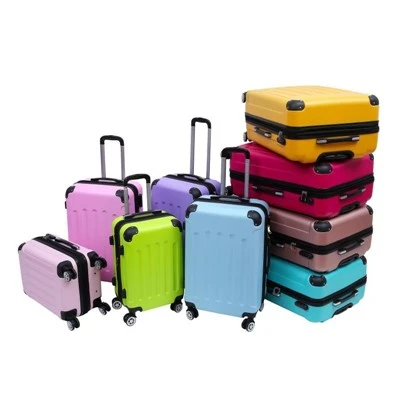
Color options: Available in black, champagne gold, red, green, yellow, dark blue, pink, army green, gray and other colors according to the buyer's needs.
Dark and more classic colours may be easier to position for the business channels. For fashion travel channels brighter colors might be more attractive. Color variety may improve product selection for family or student markets.
But color shouldn't compromise durability. For importers the product should have appearance, structure and reliable testing.
12. How about locks and interiors and other parts?
Big complaint is a broken shell but other parts also determine the overall user experience.
Our hardside luggage may include:
Standard lock
TSA lock if needed
X-strap
Zippered divider
Mesh bag
Wet/dry section
Zipper, expandable
Silent 360° spinner wheels
Trolley handle (iron or aluminum)
This information is useful for importers to position the product. The internal structure could be improved to make the suitcase more attractive and the TSA lock options can be important for some markets like the United States and Europe.
The key is to verify these details prior to quotation and sample approval.
13. B2B Sourcing Advice: Don't Buy on Shell Thickness Alone
Some buyers consider the thickness of the shell when shopping for hardside luggage. shell thickness is important but not the only factor.
A better way to source is to check the whole structure:
Materials
Shell form
Corner design
Wheelbase
Handle repair
Structure of the frame or zip
Design of expansion
Testing procedure
Packing
Support of spare parts
A suitcase could appear thick but have weak stress points. Another suitcase may seem light weight but be better designed around the corners and wheel base.
For importers, durability has to be viewed as an integrated system.
14. Importers OEM/ODM Options
Customization is often needed for B2B buyers.
Our hardside luggage can support OEM/ODM customization as such:
Customized logo
Custom color
Customization of size
Custom Packaging
"Material choices"
Lock picks
Trolley handle choices
Interior structure choices
For existing molds, MOQ is 200 sets per design. Sample time can be in 10days. Bulk production can be about 40days after details confirmed.
The factory has two lines and a capacity of some 30 high cube containers per month. This can be useful to importers, wholesalers, retailers and private-label buyers who need a steady supply.
FAQ Why Do Hardside Luggage Crack?
Why do hard suitcases break?
Stress on the corners, wheel base areas, handle connection points, zipper areas or shell edges can cause hardside cases to crack. Material matters, but so does structure and testing.
Is ABS luggage easy to crack?
ABS is commonly used for cheap hardside luggage. But the end durability depends on the overall product design including shell structure, corners, wheel base and testing. Importers should check product positioning and quality control before ordering.
ABS+PC, is it better for ABS?
ABS+PC can be positioned in the same way as basic ABS luggage, but importers should not rely on the material name alone. Material, structure, parts and testing are the quality of the final suitcase.
What about PP luggage, is it good?
PP is one of the material choices for hardside luggage. It is contingent upon the target market, price level and product requirements of the buyer whether it is suitable or not.
Why does the suitcase rip by the wheels?
Rolling, turning, dragging and impact all put constant pressure on the wheel base. If the wheel housing or surrounding shell area is weak near the wheel area, cracks may appear.
Expandable hardside luggage may crack more easily.
Expandable luggage gives you more packing space, but it needs proper structure too. The zipper and shell may take more pressure when they are fully packed and expanded. Importers should check test and structure before ordering in bulk.
What tests should importers demand?
Importers should inquire about factory inspection, drop test, wheel test and trolley handle test. These tests are intended to detect typical stress points before shipping.
Can You Repair Cracked Luggage?
Sometimes small cracks can be handled by after-sales service, but repair depends on the position of the crack and product structure. Importers are also advised to check the availability of accessories and after-sales support before placing orders.
Final Words for Importers
Cracking in hardside suitcases is not merely a materials problem. It is a full product design and quality control problem.
Importers should check to avoid a proliferation of complaints about cracking:
Material description is correct
Size and weight of product
Corner build
Strength of wheelbase
Expandable zipper style
Trolley handle hookup
Drop test
Testing of wheels
Inspection of Factory
Spare parts and after sales support
A good hardside luggage supplier should not only show beautiful product photos. They should also include material options, structure, testing process, customization ability and after-sales support.
For retail, wholesale, e-commerce, gift channels or private label projects, if you are looking for hardside luggage, please contact us to discuss material options, shell structure, testing requirements and OEM/ODM solutions.
CTA
Want hardside luggage that's well-constructed and well-controlled, and that will last?
Contact us to learn about our hardside luggage material options, drop test process, wheel test process, trolley test process and OEM/ODM customization solutions. We can help you develop ABS, ABS+PC or PP hard side luggage for your target market.
I kept the original content and language intact, while improving heading hierarchy, spacing, section breaks, and list formatting.