Why Do Hard Luggage Cases Break? A Buyer's Guide to Minimizing Damage Claims
One of the most annoying luggage problems for many travelers is to open up the baggage carousel and see a cracked hardside suitcase. According to users in travel forums and reddit discussions, hard shell luggage is often cracked after checked baggage handling, especially near the corners, wheels, frames, and handle areas.
For importers, wholesalers, private-label brands and distributors, these complaints are not just product defects. They turn into return requests, negative reviews, warranty claims and additional after sales cost.
The good news is that the majority of cracking risk can be managed before production begins. The key is in knowing where the cracks appear usually, why they appear and what the buyer should look for before placing a bulk order.
Common points of cracking in hardside luggage are covered in this guide, providing B2B buyers with a practical checklist to minimize damage claims.
Why a Cracking Problem Is a Serious B2B Risk for Hardside Luggage Buyers
Hardside luggage is popular because it looks modern, protects your belonging, and has a clean product look. But in actual travel, hard shell suitcases do take a heavy impact.
A suitcase can be dropped, pushed, stacked, dragged or thrown during transportation. The shell of the checked luggage must be able to withstand pressure from various directions.
There are several risks in cracking problems for B2B buyers:
Increased return rates
More warranty claims
Negative reviews online
Extra replacement value
Distributor confidence lower
Damage to image of private label brands
That's why importers should not be judged by appearance alone. They have to check the material, the shell structure, the corner design, the wheel base strength and the quality control process before placing a bulk order.
Hardside Luggage Common Cracking Areas
Hardside suitcases don't just crack for no reason. Most cracks occur at the point of impact and stress concentration.
1. Corners.
The corner is a very common place to crack. When a suitcase is being loaded it will usually hit the ground corner first. If a corner area is too thin, too sharp or not properly reinforced, it can crack after impact.
Typical corner problems are:
Hair cracks
worn corner edges
Corner shell deformation close to
Cracks extending from the corner to the side panel
Corner strength is especially important for checked luggage as larger sizes such as 24 inch and 28 inch luggage have more weight and more impact.
2. Wheelbase Space
The wheel base is another high risk area. Many users think the wheel is the only weak point, but often the shell or wheel housing will crack before the wheel fails.
This area is under stress from:
Rolling under load
On uneven surfaces it drags
Traveling on the side impact
Falling from height
Weight of the suitcase pressure
A good wheel system should have durable spinner wheels and a stable wheel base structure. For B2B buyers, check the wheel base and the shell together, not separately.
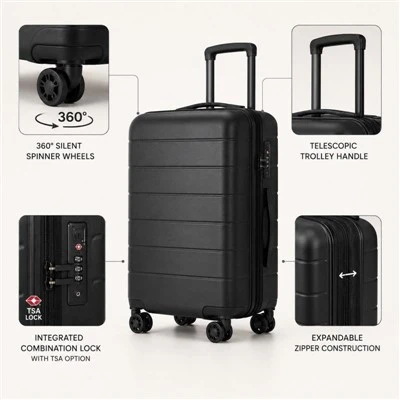
We can have 360° silent spinner wheels on our hardside luggage. Wheel testing can be part of quality control. This enables buyers to assess rolling performance and wheel durability ahead of mass production.
3. Frame & Edge Region
The edge or frame area may crack when the suitcase is subjected to side pressure or impact . This is especially true for zipper-less or frame style luggage where the frame structure plays a role in both the looks and strength.
Common problems are:
Cracks close to the frame
Uneven close post-impact
Gap between frame and shell
Edge deformation
Importers should ensure that they review frame design if the product is positioned for the medium to high-end retail, business travel or gift channels.
4. Trolley handle fixation points
The fixing points of the trolley handle also experience repeated stress. When a traveler pulls a fully loaded suitcase, forces are applied to the shell through the handle structure.
Weak fixing area: Problems may be:
Cracks around the bottom of the handle
Trolley handle loose
Shell emphasizes
Reduced stability when pulling
Iron or aluminum trolley handles can be made for our luggage. For 20 inch luggage, can make three section trolley handle. For 24 inch and 28 inch luggage, can make two section trolley handle. Buyers are required to confirm the handle material, height structure and testing requirements before production.
Why do hard-sided luggage break?
Cracking is usually a combination of material, thickness, temperature and structural design.
1. Brittleness of Material
The way the shell reacts to impact depends on the shell's material. Some materials could be more rigid, some materials could be more flexible.
For B2B buyers, material claims should not be mixed in product descriptions. ABS, ABS+PC and PP each have individual selling points and should be described separately.
The following shell materials are available:
Abstract
ABS + PC
PP
Buyers should select material based on product positioning, price level, target market and anticipated durability needs.
2. Shell is too thin
You can get away with a thinner shell to help reduce weight and cost, but then you run the risk of cracking if the structure is not well designed.
It is not enough for importers to ask if a suitcase is "lightweight." They need to ask:
What kind of material?
What is a shell structure?
Is the corner part reinforced?
Did the product survive drop testing?
The wheelbase is long enough?
Our standard sizes of hardside luggage are 20 inch, 24 inch and 28 inch. Reference net weights are between 2.8 kg, 3.5 kg and 4.5 kg depending on size and configuration. Buyers need to consider weight as well as durability, not just one selling point.
3. Low temperature.
Some plastics could become more brittle in cold environments. This can increase risk of cracking when impacted, especially for checked bags which are used for winter travel or cold climates.
If your target market is North America, Europe or other colder regions, buyers should discuss low temperature performance with the supplier.
Important Note: If the low temperature test is required, it is the responsibility of the buyer to clearly state the supplier's ability to perform the test and the conditions of the test. Do not assume low temperature performance unless sample tested or written confirmation.
4. Stress Concentrations
Stress concentration is when force is concentrated on a small area. In luggage design, this often occurs around corners, wheel bases, handle fixing points, screw positions, and frame joints.
The usual culprits are:
Design with sharp corners
Wheel well weak
Bad screw placement
Thin shell around anchor points
No ribs for reinforcements
Poor balance of shell rigidity and flexibility
Good luggage design will distribute the force more evenly and reduce the concentration of stress in high impact areas.
PC, ABS, ABS+PC and PP: What You Need to Know as a Buyer
Many buyers compare PC, ABS, ABS+PC and PP when they are sourcing hard side luggage. But product claims must always match the actual material used.
For this product line, there are options in ABS, ABS+PC, and PP. If a buyer needs pure PC, this should be confirmed separately before quoting and development of samples.
Hardside ABS Luggage
ABS is the common material for cheap hard-sided luggage. It helps buyers establish competitive price points for wholesale, e-commerce and promotional channels.
However, in the case of picking ABS luggage, buyers should consider shell strength, corner protection and drop test results.
Best for:
Entry to mid-price ranges
Bulk orders
promotional travel bags
Market with price sensitivity
Checklist for buyers:
Confirm shells structure
Corner Strength Check
Review drop test process.
Don't over-promise on premium impact resistance
Hardside Luggage ABS+PC
ABS+PC is often used by buyers who want to balance appearance, cost and performance improvement. Compared with basic ABS positioning, ABS+PC can support a more upgraded product story, if the structure and finishing are designed properly.
Best for:
Mid-level luggage brands
Private label brands
Products for e-commerce
Business travel collections
Fashion travel collection.
Buyers checklist:
Get confirmed if it is ABS+PC, not pure PC
Check for surface finishing.
Check shell flexibility and performance impact
Order in bulk only after reviewing sample test results
Hard Side PP Luggage
PP is another option for hardside case shells. It is frequently chosen when a shell material with good flexibility characteristics and a different product positioning than ABS is desired.
Best for
Collections of travel bags
Everyday luggage that lasts.
Buyers that need material differentiation
Markets where flexibility is a major selling point
Buyer To Do List:
Confirm shell thickness and structure
Verify weight by size
Test performance of drops
Kindly confirm if PP is within the target price range
Importers' Material Advice
Not all hardside luggage materials are described the same way. ABS, ABS+PC and PP should be clearly positioned as products.
What a good B2B product page should tell you:
What material is used?
What sizes are available?
What is the weight net
Whether the suitcase is extendable
What tests are included
What is the customization
What after sales support can be provided
This helps buyers make better decisions and also helps Google EEAT by providing specific, experience-based product information rather than vague marketing claims.
How to Minimize Risk of Cracking by Improved Structure
Material is important, but structure is also important. Good material can fail if things are badly designed at the stress points.
1. The Corner Rounded
Rounded corners can help with reducing sharp impact points. A suitcase geometry with softer corners will take the impact better than having sharp, thin corner edges.
For checked luggage, the rounded corner design should be considered along with shell thickness and corner reinforcement.
2. Ribs for Strengthening
For structural stability in critical areas reinforcement ribs may be used. They are often used to support the shell and restrict deformation.
And for B2B buyers, reinforcement should be discussed in terms of:
Corner zone
Spacing of wheels
Fixed points handling
Zip region or frame
larger suitcases
A 28 inch checked suitcase usually carries more weight and may need to have stronger structural support than a 20 inch carry-on suitcase.
3. Corner Guards
Corner protectors might aid in minimizing direct impact on vulnerable areas. They may be suitable for products marketed for greater durability or checked baggage use.
But corner protectors also impact cost, looks, weight, and packing design. Importers should assess their suitability for the target channel and retail price.
Some of the proper channels are:
E-commerce mid to high end.
Travel bags for business
Gift sets luggage
Outlet department stores
Collections of distributors' luggage
4. Robust wheel base design
The wheel base should be included as part of the shell structure. Weak wheel base even good wheels may not prevent a suitcase from failing.
A good design should take into account:
Strength of wheel wells
Stability of screw fixation
Shell thickness round wheel base
Impact resistance at corners
Rolling performance under load
Since wheel damage and shell cracking are often inter-related, buyers may want both wheel testing and drop testing to be included as part of their quality control requirements.
What tests should buyers ask about with hardside luggage?
One of the most important ways to reduce damage claims is testing. A sample may look good in pictures, but test results help buyers understand if the suitcase is suitable for real travel conditions.
1. Drop Test
Drop testing is important since luggage is often dropped during transit and baggage handling.
Buyers should ask themselves:
Is drop testing part of quality control?
What sizes of suitcases are tested?
Suitcase tested with load?
What areas are checked after the test?
Are corners checked, wheel bases and handle fixing points?
We can do drop tests as part of our quality control process. This is helpful for buyers who want to lower the risk of cracking prior to bulk shipment.
2. Test of Impact
Impact testing provides an evaluation of the response of the shell to a direct load.
If your market is one that expects high durability, ask the supplier:
Can you set up impact testing?
Tested area?
What is the impact condition?
Is the outcome noted?
Is the shell cracked, misshapen, or showing signs of stress?
Important note: Please check impact test requirements before production. Buyers should request it separately, if it is not included in the standard quality control test.
3. Low Temperature Tests
For markets where luggage will be used in cold weather conditions, testing at low temperature may be important.
Things for buyers to ask:
Is there a low temperature test?
What temperature condition is applied?
How long is the sample conditioned prior to testing?
Is there exposure to low temperatures followed by drop or impact testing?
What material is better for the target market?
Important Note: Do not make any cold resistance claims without either testing or getting confirmation from the supplier.
4. Wheel Test
The wheel testing is important because the wheel base is one of the common cracking areas.
Buyers should ask:
Are the wheels load tested?
Do you test rolling distance?
Do you listen for wheel noise and smoothness?
After testing, do you check the wheel base?
Do you have spare wheels or replacement parts?
We can make our hardside luggage with 360° silent spinner wheels. We can do wheel testing in quality control.
5. Test of the Trolley Handle
The trolley handle is directly connected to the shell, so the handle testing is also related to the risk of cracking.
Buyers should ask:
Is the handle on the trolley tested?
"Is the handle iron or aluminum?"
How many levels of height does it have?
Is the handle fixation point checked after testing?
Are there any cracks or looseness in the shell at the base of the handle?
We can make our luggage with iron or aluminium trolley handles. The 20-inch size can be used with a 3-section trolley handle. 24-inch and 28-inch sizes can be used with a 2-section trolley handle.
B2B Crack Prevention Checklist
Importers should follow this checklist before placing a hardside luggage order.
|
Checkpoint |
What to Ask |
Why It Matters |
|
Shell Material |
Is it ABS, ABS+PC, or PP? |
Different materials have different positioning and durability expectations |
|
Size |
Is it 20 inch, 24 inch, 28 inch, or a three-piece set? |
Larger luggage usually faces heavier load and stronger impact |
|
Net Weight |
What is the weight of each size? |
Lightweight claims should be supported by real parameters |
|
Corner Design |
Are corners rounded or reinforced? |
Corners are common cracking points |
|
Wheel Base |
Is the wheel housing strong enough? |
Wheel base cracks can lead to major damage claims |
|
Handle Fixing Area |
Is the trolley handle area reinforced? |
Pulling force can create shell stress |
|
Drop Test |
Is drop testing included? |
Helps evaluate impact during travel |
|
Impact Test |
Can impact testing be arranged if needed? |
Useful for high-durability product lines |
|
Low Temperature Test |
Is it available for cold markets? |
Helps evaluate cracking risk in cold conditions |
|
Wheel Test |
Are wheels tested under load? |
Helps reduce wheel and wheel-base claims |
|
After-Sales Parts |
Are spare parts available? |
Helps distributors solve claims faster |
How importers can limit damage claims before production
1. Match Material to Market Positioning
For a premium claim, do not go for the cheapest material. If your product is positioned for business travelers, gift channels or mid to high end e-commerce, the material and structure should support that positioning.
ABS could be a good fit for products where cost is a factor. If you are seeking a higher price point and more durable products, you might want to consider using ABS+PC or PP for your upgraded product lines.
2. See the structure, not just the shell
A good hardside suitcase is more than just a shell. Buyers should anticipate:
Design of corners
Wheel base building
Fixing spot for trolley handle
Zipper or frame area
Internal support
Shell flexibility and thickness
This is especially important for checked baggage sizes such as 24 inch and 28 inch.
3. Test not only the material, but the entire product
Material data is insufficient. A suitcase should be tested as a whole product, since cracks are often found at the joints of different parts.
Buyers are advised to test:
Ending luggage
Wheels and wheelbase
Corners
Fixing points handle
Border zone or frame
Shell after drop-impact
This provides a more realistic view of product durability.
4. Prepare a Spare Parts and After Sales Plan
Post sales support is important, even with good quality control.
Importers should ask if the supplier can provide:
Wheels for replacement
Support for Accessories
Quality control support
Service after sales
Open communication to the distributors
After-sales service may include accessories, quality inspection and service support. This helps ease pressure on B2B buyers when handling distributor or customer claims.
Benefits of Partnering with an OEM/ODM Hardside Luggage Supplier
OEM/ODM support enables importers to create a product line tailored to the target market.
Our hard side luggage can take:
ABS, ABS+PC, PP material Selection
Standard sizes : 20 inch , 24 inch , 28 inch .
Expandable architecture
Silent 360° rotating wheels
Regular lock, TSA lock on special request
X straps, zipper divider, mesh pocket and wet/dry compartment
Customizable logo, color, size and packaging
Standard export carton package
Accessories and customer support
The MOQ for existing molds can be 200 sets for each style. The sample time is within 10 days and the bulk production is about 40 days after the details confirmation.
The factory has two production lines and produces about 30 high-cube containers per month. This helps B2B buyers who require a reliable supply for wholesale, e-commerce, distributor or private label projects.
FAQ: Cracking of Hardside Suitcase
Why Do Hardside Luggage Crack After Flights?
Hardside suitcases can crack due to impact, the brittleness of the material, thin shell construction, cold temperature, stress concentration at corners, wheel bases, frames and handle fixing points.
Where do the hardside suitcases break?
Common cracking areas are corners, wheel bases, frame edges and trolley handle fixing points. These are the areas that take the most abuse during baggage handling and day-to-day travel.
Is ABS luggage easy to break?
ABS is often used in hardside luggage where cost is a consideration. Cracking easily depends on the shell structure, thickness, corner design and testing. Buyers should look for the drop test results and be sceptical of any claim of premium durability without proof.
Is ABS+PC better than ABS?
Depending on the structure and the design of the product, ABS+PC can be considered an enhanced option compared to basic ABS. Buyers should confirm the exact material, shell design and test results before bulk ordering.
Is PP good for hard side luggage?
PP can be a good material choice for hardside luggage especially for buyers looking for a different mix of flexibility, weight and durability positioning. The final performance still relies on shell design and testing.
What tests should importers require to reduce cracking claims?
Importers should ask for drop testing, wheel testing, trolley testing and full product inspection. Buyers may also request impact testing and low temperature testing where applicable for markets with higher durability requirements.
Is it possible to completely prevent cracking of suitcases?
No suitcase can be guaranteed against all travel damage, especially if baggage handling is rough. But good material choice, structure, drop testing, wheel testing and after-sales support can reduce the risk of cracking and damage claims.
Top Tips For Buyers Of Hardside Luggage
Cracking is one of the biggest quality risks for hardside luggage. For B2B buyers, it needs to be done before production, not after the customer complaints come in.
Importers should focus on limiting damage claims by:
Proper material selection
Robust corner design
Wheel base, reinforced frame
Tight trolley handle fixing positions
Drop test
Wheel testing
Optional impact and low temperature testing
Transparent Spare Parts & After-Sales Services
A good hardside luggage supplier should not only sell good product photos. They need to help buyers understand material options, structure risks, testing methods, customisation opportunities and after-sales solutions.
CTA: Download the Crack Prevention Checklist
Want a hardside bag that's less prone to cracking and less likely to lead to property-damage claims?
Get a hardside suitcase crack prevention checklist. Contact us. We can help you choose the materials, design the corner structure and wheelbase, drop tests and wheel tests, spare parts support, and OEM/ODM solutions for your target market.