Quality of Telescopic Handle on Hardside Luggage – QC Guide for Importers
Importers of hardside luggage consider the telescopic handle as one of the most important quality checks. The suitcase may have a robust shell, smooth spinner wheels and appealing design but if the trolley handle shakes, gets stuck, does not retract or has a broken button, the customer will immediately feel that the entire suitcase is of low quality.
This is especially true for e-commerce sellers, distributors, gift channels and private-label luggage brands. A lot of customers try the handle before anything else. They pick it up, push the button, push it down and roll the suitcase. A loose or wobbly handle can directly impact purchase confidence and product reviews.
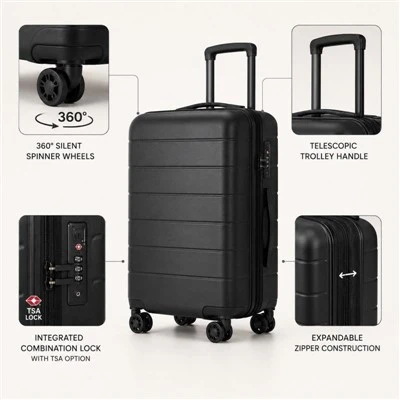
Our hard side luggage can be made with either iron trolley handles or aluminum trolley handles. 20 inch luggage can be made with a three-section handle for common sizes, 24 inch and 28 inch luggage can be made with two-section handles. For importers the right choice of handle should depend on product positioning, target price, size, weight and expected usage scenario.
The Importance of a Telescopic Handle in Hardside Luggage
The telescopic handle is not just a pulling part. It links the user's hand, the suitcase body and the rolling system. The handle is repeatedly subjected to pulling, pushing, lifting force, vibration and impact during traveling, when the luggage is full.
Typical problems with handles are:
too much wiggle
Handle being stuck when pulled up
Non-returning smooth handling
Button failure
Uneven handle tubes
loose bits of plastic
Rolling shakes
Handle tubes for repeated use bending
Importers could face customer complaints, returns, replacement requests, and poor product ratings as a result of such problems.
A good telescopic handle should feel solid, extend easily, lock solidly at each setting and retract without sticking. It should also be appropriate to the suitcase size and target market. A carry-on bag, a medium checked suitcase and a large 28 inch suitcase are not to be judged equally.
1. Typical Telescopic Handle Importer Issues To Look Out For
Wobble Handle
Some movement in the handles is normal as the telescopic tubes will need clearance to move up and down. Too much wobble, however, can make the suitcase feel cheap and unsteady.
When fully extended, importers should feel if the handle wobbles from side to side. This problem may be more noticeable in larger cases when fully loaded.
Jamming Management
If a handle does not slide freely, it can create a poor user experience. Causes of jamming can be tube deformation, poor fitting accuracy, rough plastic parts, or misaligned internal structure.
While inspecting the samples, pull up and push down the handle several times. The movement must be smooth and consistent.
Handle Not Retracted
If the handle does not retract fully, a suitcase is difficult to store, pack, or ship. This problem is particularly serious for e-commerce because customers may notice it right after unboxing.
Importers should check whether the handle can be returned to its lowest position without having to force it.
Buttons Gone Bad
It is a small piece but it controls the whole mechanism of locking and releasing. From the customer's point of view a loose, stuck, or ill-fitting button is a major defect.
Inspection should test the button many times, not just once pressed.
2. Aluminum Tube, Iron Tube and Plastic Parts: Why the Price Difference?
The telescopic handles are often made of metal tubes, internal locking parts, buttons and plastic fittings. The material chosen affects cost, weight, appearance and perceived quality.
Our hardside luggage can be made with either iron or aluminum trolley handles. This flexibility is useful for importers as different markets may require different price levels and product positioning.
Aluminum Handle for Trolley
Aluminium handles are often used as buyers often want a lighter and more premium feel. They might be more appropriate for mid-range to higher-end hardside luggage, especially products targeting business travel, fashion travel, or improved user experience.
The key benefits could include:
Lighter feel
Improved appearance
More premium product placing;
Suitable for the top end lines of luggage
However, importers still have to check tube thickness, handle stability, button performance and cycle test results. Aluminum doesn't always equal better quality unless the whole handle design is well thought out.
Iron Trolley Handle
Buyers looking for a more cost controlled option often choose iron handles. They may be suitable for value-driven products or projects that require price competitiveness.
Key things to look for include:
Surface finishing
Strength of Tube
Glides smoothly
Long-term requirements for rust prevention
Weight of handle (overall)
But if the structure, fit and QC process are good, then iron handles can still be a practical choice.
Plastic Components
Plastic is commonly used in buttons, connectors, covers and internal lock parts. The metal tube might be strong but if the plastic parts are bad, the handle might break anyway.
Importers must check:
Button feeling
Locking precision
Cracks around plastic components
Loose fitting
If the handle locks tightly at each position
A stable telescopic handle is not just about the metal tube, but the entire system.
3. What Is a Handle Jerk Test?
The handle jerk test is used to know the performance of the trolley handle under sudden pulling force. In real travel, users are not always pulling the suitcase gently. They can pick up, drag, twist or pull the luggage fast over uneven ground.
The handle jerk test is used to test the stability of the structure of the handle after several sudden pull actions.
Importers need to perform this test to determine:
If the handle wobbles
Whether the button is still operating normally
if the tubes are bent or deformed
If the handle base remains stable
Whether plastic parts crack
whether the handle can still be smoothly pulled back
And the important thing is not if the handle will hold one strong tug. What is more important is the question whether the handle still works correctly after repeated stress.
Before confirming mass production, importers should request the actual handle test standard, test conditions and inspection process of the supplier, as different suppliers may have different internal test methods.
4. What is Handle Cycle Testing?
The handle cycle test is to test the performance of the telescopic handle after repeatedly pulling up and pushing down.
This test is important, as most handle problems do not occur until the first use. They usually appear after a lot of opening, locking, unlocking and retracting.
A handle cycle test can assist importers to evaluate:
Smoothness of sliding
Durability of buttons
Stability of locking
Tube orientation
Durability of plastic parts
Long term user experience
During sample review, importers should not just pull the handle once. They have to do the same thing many times and see if the feeling changes.
The supplier must have a clear luggage QC process for bulk orders. Our quality control can have trolley handle testing, together with other inspection items as drop testing, wheel testing.
5. Are Multi-Position Telescopic Handles Helpful?
A multi-position handle can improve user comfort as users have different heights and usage habits. But more positions means more locking points, more internal parts and more areas that need testing.
Common hardside luggage sizes include 20 inch, 24 inch, and 28 inch, with 20 inch luggage having a three-section handle and 24 inch and 28 inch luggage having two-section handles.
When Multiple-Position Handles Are Needed
Multi-position handles are more suited for:
Carry-on bags
Business travel bags
E-Commerce Upper-Market Products
Gift routes
private label luggage brands
Products that focus on comfort and user experience
What to Look for in Importers
When selecting a multi-position handle, importers should verify:
whether each position clearly locks
If the button is easily off
The handle vibrates at each level or not
Whether the handle fully retracts
Whether the structure is stable after repeated uses
When the target market values comfort, convenience and better user experience, a multi-position handle is worth doing. If cost is the main factor, a simpler handle construction may be better suited to your project.
6. Telescopic Handle Importer Quality Control Checklist
Hardside luggage orders should be confirmed after importers carefully check the telescopic handle.
Basic Function Test
Lift the handle, and push it down a few times.
Check out
Does it slide easily?
Does it jam up?
Does it withdraw totally?
Does the button work each time?
Does the handle lock in each position?
Check for Wobble
Pull the handle all the way out and rock it slowly from side to side.
See:
Is the wobble good enough?
Is the handle screwed on tight?
Does the shaking get worse when fully extended?
The handle is too loose for what you are paying for the product.
Check Button
Press the button again and again.
Verify:
Does the button work?
Does it feel loose on.
Does it hang?
Does the handle release smoothly?
Does it work at all height positions?
Loading Rolling Check
Pack your suitcase, then push the handle out as far as it will go and roll it.
Check.
Is the handle too wobbly when rolling?
Is the handle still locked in?
Is the case static?
Does it bend or twist when you pull on the handle?
Watch Retraction
Repeated use, push down the handle.
Cheque:
Does it return unobtrusively?
Does it split in two?
Does it require more force?
Will it all fit in the suitcase body?
Base Check Handle
The handle base is the point of connection between the trolley system and the luggage body. This is an area to look at closely.
Review:
Is the handle strong?
Any cracks in the area of where it is fixed?
Tighten screws?
Is the base of the handle moved abnormally?
Shell after testing Will there be stress marks on the shell?
7. Quality of Telescopic Handle and Its Relation to Overall Quality of Luggage
The handle quality should not be considered separately from the body of the suitcase. The shell material, size, weight, wheel system and handle structure all combine together.
Our hardside luggage can be made with ABS, ABS+PC or PP material. Standard sizes are 20 inch, 24 inch and 28 inch. The net weight can be about 2.8 kg, 3.5 kg and 4.5 kg depending on the size and configuration.
For larger luggage, the strength and stability of the handles become more important, as users may pack in more weight and pull the suitcase over longer distances.
Importers should bear in mind the handle with:
Shell material
Size of suitcase
Performance of Wheels
Tube material handling
Layout section management
Structure - Internal
Retail target price
Post-sale policy
You can't just focus on one premium component; you need a well-balanced product.
8. Suggested Specification Table for Importers
|
QC Item |
What to Check |
Why It Matters |
|
Tube Material |
Iron or aluminum trolley handle |
Affects cost, weight, and positioning |
|
Handle Sections |
Three-section or two-section structure |
Affects comfort and stability |
|
Button Function |
Press repeatedly at each position |
Prevents button failure complaints |
|
Sliding Smoothness |
Pull up and push down repeatedly |
Checks jamming and retraction issues |
|
Wobble Level |
Shake handle when fully extended |
Evaluates perceived quality |
|
Locking Position |
Test every height position |
Ensures user comfort and safety |
|
Handle Base |
Check fixing area and shell connection |
Prevents structural looseness |
|
Loaded Rolling |
Roll the suitcase with weight inside |
Simulates real travel use |
|
Cycle Test |
Repeat pull-up and push-down actions |
Checks long-term durability |
|
Jerk Test |
Apply sudden pulling force |
Checks handle strength under stress |
FAQ of Quality of Telescopic Handle for Hardside Luggage
Why does a suitcase sometimes have a wobbly pull-out handle?
The handle tubes need a little play to move smoothly, but a poor fit accuracy, the tubes being too weak in structure, loose plastic parts or the handle base being unstable can cause too much wobble.
The aluminum trolley handle is not always better than iron.
Not necessarily. Aluminum handles are frequently used in lighter weight and higher end positioning, while iron handles are suitable for cost controlled models. Importers should compare the entire handle structure, not just the material.
What is a handle cycle test ?
A handle cycle test involves testing the telescopic handle through a number of pull-up and push-down actions. Also useful to assess slide smoothness, button durability, lock stability and long-term performance.
What is a handle jerk test ?
A handle jerk test tests the performance of the handle with sudden pulling force. It is useful for checking if the handle loosens, bends, cracks or stops working normally after stress.
Is 3 section handle better than 2 section handle?
It depends on the suitcase size and the target user. A three-section handle is good for carry-on luggage and user comfort. Larger luggage might be more practical with a two-section handle.
What to look for when checking bags?
Importers should check the handle slide, button function, locking positions, wobble level, retraction, strength of the handle base, loaded rolling performance, and supplier test reports or internal QC standards.
Final Words of Advice for Importers
One of the most obvious and most commonly used parts of hardside luggage is a telescopic handle. If the handle is loose or sticks or breaks after little use, customers will lose faith in the entire suitcase.
For importers the best approach is to look at the whole handle system:
Material metal tube
Quality of plastic parts
Button Functionality
Lock positions
Wobble Handling
Easy to draw back
handle the base strength
Results of jerk test.
Cycle test results
Post-Sales Support
A good supplier should be able to tell you the handle structure, the material options, the quality control process, and the replacement parts support.
Our hardside luggage have iron or aluminum trolley handles, 20 inch / 24 inch / 28 inch, OEM/ODM, trolley handle testing and quality control. If you are a buyer developing mid-range or high-end hardside luggage, review handle quality early in sample approval.
CTA CTA
Want to check the quality of the telescopic handle before a big luggage order?
Contact us for our handle test standard, check out trolley handle options and discuss OEM/ODM hardside luggage options for your market. We can help you compare handle materials, size structures, QC checkpoints, packaging, MOQ and production lead time before mass production.