Expandable Hardside Luggage: Good Selling Point or Return Risk?
Expandable hardside luggage is one of the most attractive selling points for modern suitcase buyers. For travelers, it gives them extra packing flexibility. For online sellers and importers, it creates a clear product benefit that is easy to explain on product pages, ads, and comparison charts.
However, expandable luggage is not only a marketing feature. If the expanded size, structure, and usage limits are not clearly explained, it can also become a source of complaints, returns, and customer misunderstanding.
For B2B buyers, the key question is not simply "Should we add expandable zipper?" The better question is: "Can this expandable design improve conversion without increasing after-sales risk?"
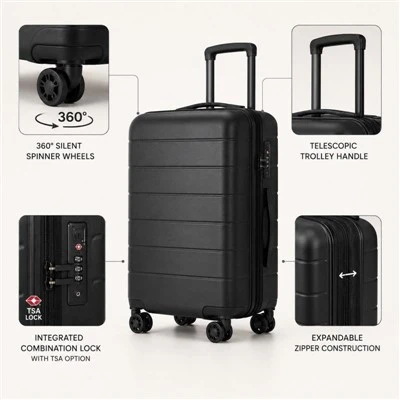
Our hardside luggage can be made with expandable zipper, and regular sizes include 20 inch, 24 inch, and 28 inch. For importers, wholesalers, distributors, and private-label brands, expandable and non-expandable versions should be compared carefully before confirming bulk orders.
Why Expandable Hardside Luggage Is a High-Conversion Selling Point
Expandable luggage is easy for customers to understand. It solves a very common travel problem: people often return with more items than they packed at the start of the trip.
A suitcase with expandable zipper gives customers extra space when needed, which makes the product feel more practical and flexible.
For e-commerce product pages, expandable luggage can help improve conversion because it gives buyers a clear reason to choose one suitcase over another. Instead of only comparing color, size, and price, customers can see an added function that may be useful during real travel.
Expandable hardside luggage is especially attractive for:
Family travelers who may pack more items
Business travelers who need extra space for documents or clothing
Students who carry seasonal items
Short-trip travelers who want one suitcase for different travel lengths
Online buyers who compare multiple suitcase listings before purchase
For B2B importers, "expandable" can be positioned as a practical upgrade rather than a luxury feature. It is simple to explain, visible in product photos, and suitable for product comparison charts.
But Expandable Design Can Also Create Return Risk
The main risk of expandable hardside luggage is customer expectation.
Some customers may think expandable luggage means unlimited extra capacity. Others may not realize that the suitcase becomes thicker after expansion. If the product page does not explain this clearly, the customer may feel misled.
Common return or complaint risks include:
The expanded suitcase looks bulkier than expected
The expanded size may not fit certain carry-on limits
The suitcase becomes harder to close when overpacked
The zipper area may feel less rigid than a fixed shell structure
Customers may think the suitcase capacity is larger than the actual usable space
Buyers may not understand that expansion is designed for temporary extra packing, not overloading
For importers, this is why product page accuracy matters. A good expandable suitcase can still create bad reviews if the selling page overpromises.
Will the Expanded Size Exceed Airline Limits?
This is one of the most important questions for expandable luggage, especially for 20 inch carry-on models.
A 20 inch suitcase may be marketed as a carry-on size, but if the expandable zipper is opened, the total depth may increase. Depending on the airline and market, the expanded size may no longer meet certain carry-on restrictions.
This does not mean expandable carry-on luggage is a bad product. It means the product page should clearly distinguish between:
Standard size before expansion
Expanded size after opening the expandable zipper
Shell size vs overall size including wheels and handles
Carry-on use vs checked luggage use
Recommended use before and after expansion
For B2B buyers selling to the United States, Europe, South America, the Middle East, Africa, or other markets, airline size expectations may differ. Importers should confirm exact dimensions before publishing product listings.
Does the Expandable Layer Weaken the Structure?
Expandable hardside luggage usually adds a fabric zipper layer between hard shell parts. This creates more packing flexibility, but it also changes the structure of the suitcase.
Compared with a non-expandable hard shell suitcase, an expandable suitcase may have:
More zipper stress points
A softer middle expansion area
More pressure when overpacked
More deformation if customers exceed the recommended load
More dependence on zipper quality and stitching strength
This is why expandable luggage should not be evaluated only by appearance. Importers should check the whole structure, including the shell, zipper, wheel base, handle, and internal support.
Our hardside luggage can be made with ABS, ABS+PC, or PP material. Different materials have different selling points, so importers should not mix material claims in the same product page unless the product specification is confirmed.
Quality control can include factory inspection, drop testing, wheel testing, and trolley testing. For expandable luggage, buyers should also pay attention to zipper smoothness, expansion layer stitching, and structural stability after the suitcase is packed.
Which Sizes Are More Suitable for Expandable Design: 20, 24, or 28 Inch?
Expandable zipper can be used across luggage sizes, but the selling logic is different for each size.
20 Inch Expandable Hardside Luggage
A 20 inch expandable suitcase can be attractive for short trips, business travel, and cabin-size buyers. It gives users flexibility when they need extra packing space.
However, this size also needs the clearest product page explanation. Once expanded, the suitcase may become thicker, and buyers should check airline carry-on limits before travel.
For importers, 20 inch expandable luggage is suitable when the product page clearly explains standard size and expanded size separately.
24 Inch Expandable Hardside Luggage
A 24 inch expandable suitcase is often a safer size for the expandable feature because it is usually used as checked luggage. Customers are less likely to expect it to meet carry-on restrictions.
This size is suitable for medium-length trips, family use, student use, and general travel. For many B2B sellers, 24 inch expandable luggage can be a strong balance between functionality and return risk.
28 Inch Expandable Hardside Luggage
A 28 inch expandable suitcase offers more packing flexibility for long trips and family travel. However, the larger the suitcase, the more important it is to control overpacking.
When expanded and fully loaded, the suitcase may put more pressure on wheels, handles, zipper areas, and the shell structure. Importers should pay attention to rolling performance, trolley strength, wheel base stability, and total product weight.
Our regular hardside luggage sizes include 20 inch, 24 inch, and 28 inch, with approximate net weights of 2.8 kg, 3.5 kg, and 4.5 kg depending on size and configuration. For expandable versions, buyers should confirm the final specification before mass production.
B2B Selection Advice: When Should Importers Choose Expandable Luggage?
Expandable hardside luggage is a good option when the buyer wants a more flexible and value-added product.
It is suitable for:
Mid-range and high-end e-commerce sellers
Private-label luggage brands
Wholesale distributors
Retail chains
Gift channels
Travel product sellers
Family travel product lines
Business travel product lines
Because expandable luggage has a clearer selling point, it can help sellers create product differentiation. However, it should be supported by accurate size information, reliable zipper quality, and clear customer instructions.
For cost-sensitive promotional products, non-expandable luggage may still be a better option because it can simplify structure and reduce possible misunderstanding.
Expandable vs Non-Expandable Hardside Luggage
|
Feature |
Expandable Hardside Luggage |
Non-Expandable Hardside Luggage |
|
Selling Point |
Extra packing flexibility |
Simple and stable structure |
|
Product Page Appeal |
Stronger feature explanation |
Easier specification control |
|
Customer Expectation |
Needs clear size explanation |
Easier to understand |
|
Structure |
More zipper and expansion layer details |
More fixed shell structure |
|
Return Risk |
Higher if size is unclear |
Lower from size misunderstanding |
|
Best For |
Mid-range, e-commerce, travel flexibility |
Entry-level, simple product lines, cost control |
Both options can work well. The right choice depends on the target market, price point, sales channel, and product positioning.
OEM/ODM Considerations for Expandable Hardside Luggage
For B2B buyers, expandable luggage should be reviewed as part of the full OEM/ODM specification.
Before confirming an order, importers should discuss:
Size: 20 inch, 24 inch, 28 inch, or three-piece set
Shell material: ABS, ABS+PC, or PP
Expandable zipper requirement
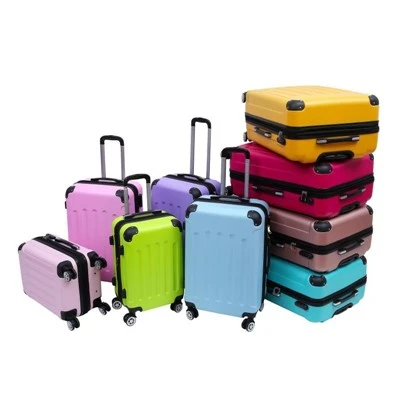
Color options
Logo customization
Packaging customization
Wheel structure and silent wheel design
Trolley handle material
Lock type
Interior layout
Replacement parts and after-sales support
MOQ and lead time
Our hardside luggage supports OEM/ODM customization, including logo, color, size, and packaging. For existing molds, the MOQ can be 200 sets per style. Sample time can be within 10 days, and bulk production can take around 40 days after details are confirmed.
FAQ: Expandable Hardside Luggage
Is expandable hardside luggage worth it?
Yes, expandable hardside luggage can be a strong selling point because it gives travelers extra packing flexibility. However, sellers should clearly explain standard size, expanded size, and recommended usage to avoid misunderstanding.
Does expandable luggage exceed carry-on size limits?
It may, depending on the suitcase size and airline requirements. For 20 inch carry-on models, importers should clearly show the size before and after expansion and remind customers to check airline rules.
Does the expandable zipper reduce suitcase strength?
The expandable layer changes the suitcase structure because it adds a fabric zipper section between hard shell parts. This does not automatically mean the suitcase is weak, but buyers should check zipper quality, stitching, shell support, and loaded testing before bulk orders.
Which size is best for expandable luggage?
20 inch expandable luggage is attractive for short trips but needs clear carry-on size explanation. 24 inch is often a balanced option for checked luggage. 28 inch offers more packing flexibility but needs stronger attention to wheel, handle, zipper, and shell performance.
What should importers confirm before ordering expandable luggage?
Importers should confirm standard size, expanded size, shell material, zipper quality, net weight, wheel testing, handle testing, drop testing, packaging, MOQ, lead time, and replacement parts support.
Final Buying Advice
Expandable hardside luggage can be a good selling point, but only when the product is positioned and described correctly.
For importers, the biggest opportunity is higher product appeal and stronger differentiation. The biggest risk is unclear size information and overpromising on capacity.
A good expandable luggage program should include:
Accurate size information
Clear expanded-size explanation
Reliable zipper structure
Suitable shell material
Stable wheels and trolley handle
Interior layout that supports real travel use
After-sales support and replacement parts availability
Honest product page wording
Expandable luggage should not be sold as "more space with no trade-off." It should be presented as "extra packing flexibility with clear usage guidance."
That is the better way to improve conversion, reduce returns, and build long-term customer trust.
CTA
Looking for expandable vs non-expandable hardside luggage options?
Contact us to get an expandable vs non-expandable cost sheet, compare available shell materials, review 20/24/28 inch luggage options, and discuss OEM/ODM customization for your target market.