Why Do Hard Suitcases Get Broken? What importers need to know before buying in bulk
Why Do Hardshell Suitcases Break?
For importers, wholesalers and private label luggage brands, a cracked hardside suitcase is more than a product defect. This can cause customer complaints, returns, negative reviews, additional replacement costs and long term damage to your brand reputation.
In travel forums and Reddit-like threads, buyers often report similar issues: corner cracks after airport handling, cracks around the wheel area, shell dents after impact or luggage that looks okay at first but fails after multiple trips.
For B2B buyers, the real question isn't just "Is this suitcase strong? A better question is:
Where is the suitcase likely to break? How can the supplier prevent this before mass production?
This guide highlights the most common cracking points, the main causes of shell failure and what importers should check before placing a bulk order.
Common Crack Complaints: What Hardside Luggage Usually Doesn't Do
Most cracks in hardside suitcases happen in a few high-stress areas. These are the parts importers should pay attention to during sample evaluation and pre-shipment inspection.
1. Cracks in the corners
The corners are the most common impact points in shipping, airport handling and everyday use. When a suitcase is dropped, thrown or stacked under pressure, the corners take the brunt of the shock.
If the corner design is too sharp, the shell material is too brittle, or the internal reinforcement is weak, cracks may originate from the corner and propagate along the shell.
2. Cracks in Wheel Area
Another common problem area is the wheel area. The wheels bear the weight of the suitcase but also receive the vibration, pulling force and impact of uneven ground.
If the wheel base is not sufficiently reinforced, stress can build up around screw holes or mounting points. This can lead to cracking around the wheel housing over time.
3. Dents and stress marks on shell
Not all durability failures are started by a visible crack. Some hard-shell suitcases get dents, whitening or stress lines on the shell.
These signs tend to indicate that the shell has absorbed the impact or pressure. If the material or construction is not strong enough, dents may develop into cracks later on.
5 reasons why hardside suitcases break
1. Excessive ABS content
ABS is popular in hardside luggage because it is inexpensive and suitable for mass market products. But if a suitcase relies too heavily on ABS and not enough on impact-resistant formulation or structural support, it may be more vulnerable under strong impact.
This isn't to say that ABS luggage is always bad quality. ABS or ABS+PC luggage can still be a practical option for supermarket channels, discount retail and price sensitive markets. The secret is finding the right materials to match the target market, expected retail price and quality requirements.
ABS+PC or PP options are more suitable for the product design and budget if you want a better durability positioning.
2. Shell Thickness Is Too Thin
A hard-shell suitcase has to balance strength, weight, flexibility and cost. If the shell is too thin, it may look lightweight but can also lose impact resistance.
Thin shells are prone to deforming under pressure, especially at corners, zippers, wheel areas, and handle mount points.
Importers should ask not only name of the material. They should also verify shell thickness, weight, structure and testing requirements before approving mass production.
3. Corners without Reinforcement Ribs
Reinforcement ribs distribute impact force across the shell. Without a rib structure, stress could remain concentrated in one area, particularly at corners and edges.
A suitcase with rounded corners, proper rib structure and a stronger corner design usually has better impact resistance than a shell with flat, thin or sharp stress points.
This is important for B2B buyers because two suitcases can be labeled "ABS+PC" or "PP" but the actual durability can be very different because of mold design and internal structure.
4. Stress Concentration at Wheel Base
For hardside luggage, one of the most important aspects is wheel performance. A suitcase might pass a cursory visual inspection but fail after repeated rolling or heavy loading.
When rolling the full suitcase the wheel area needs to bear the weight. If the wheel seat, screw position or inner support is weak, the wheel seat may crack.
The wheel test should not be a detail for the importers. This impacts the customer experience, product reviews and after-sales costs directly.
5. Lower toughness of materials in cold environments
Certain plastic materials lose flexibility at low temperatures. Impact resistance may be reduced if the shell becomes less tough.
This is important to buyers who sell into markets that have cold winters, or have to ship long distances, or handle product at airports in cold temperatures.
Importers should find out if they require low temperature impact testing for their market before bulk buying.
How manufacturers can reduce the risk of cracking
Material alone should not be enough for a good suitcase manufacturer. Durability is the combination of material, structure, mold design, parts and quality control.
1. Rounded Corner Design
Rounding the corners reduces the stress concentration. In comparison with sharp corner, a smoother corner structure can spread the impact force more evenly.
This is particularly important for checked luggage and large suitcases i.e. 24-inch and 28-inch.
2.Structure of Rib
The rib structure can reinforce the important areas without weighing down the entire suitcase. Often used around corners, edges and load bearing areas.
Bulk order buyers should check that the sample design contains sufficient reinforcement in high-stress areas.
3. Corner Protectors Options
Corner protectors for travel luggage set for higher durability or premium use can offer an extra layer of protection.
They can also help to create a better visual impact for business travel or fashion travel collections.
4. Improved Material Matching
Materials appropriate for different market positions.
ABS or ABS+PC can be a practical choice for price-sensitive channels. If durability is a key selling point, ABS+PC or PP can be considered, depending on the product design, target price and market needs.
The trick is not to pick material just by name. Importers should consider the entire specification, including shell construction, weight, expandable design, wheel quality, handle system and test standard.
What importers need to watch out for before bulk buying
Importers need to not rely on supplier product photos or product descriptions before placing a bulk order. A true durability check should involve sample testing and inspection of high risk areas.
1. Drop Test
A drop test is used to assess the impact resistance of the shell, corners, wheels, handles and lock area.
Buyers should pay particular attention to:
Damage to the corner
Cracks in the Shell
B. Cracks at the wheel well
Loosen the knob
Zipper damage,
Shell disfigurement
2. Loaded Wheel Test
A suitcase rolls easily when empty, but that is not how the real world of travel works. The loaded wheel test is used to test wheel durability under weight.
Importers must verify:
Whether the wheels keep smooth
If the wheel base is cracked.
If screws loosen
If the suitcase falls over after rolling
Whether the wheel housing has stress marks
3. Low Temperature Impact Test
For a purchaser worried about cold markets, low temperature impact testing can help to minimize the risk of winter time cracking.
The test is particularly important for North American and European markets where luggage could be exposed to cold temperatures in airport environments, outdoor transportation and winter travel use.
4. Handling and Trolley Test
Another durability point of importance is the trolley system. For hardside luggage, buyers should check if the trolley is stable, smooth and is suitable for the suitcase size.
Typical configurations could include 20 inch luggage with a 3-section trolley and 24 inch or 28 inch luggage with a 2-section trolley. The buyer has the option of choosing an iron trolley or an aluminum trolley.
5. Pre-Shipment Quality Control
Importers should inspect the factory before shipment for shell, wheels, trolley, lock, zipper, interior, packaging, and overall appearance.
Quality control can not just be about how the suitcase looks. It should also verify that the suitcase is ready for actual transportation and retail sale.
Visual aid: Hardside luggage shows signs of cracking
Use a simple suitcase outline for your blog image, infographic or Reddit post, and highlight these high risk areas:
Summary of Crack Location Map
Image caption Common Places for Cracks on Hard Side Luggage
Designated Areas:
Top corner crack.
Crack bottom corner
Wheelbase break
Shell dent region
Mounting stress area handler
Zipper edge stress zone
B2B Hardside Luggage Buyers Specification Checklist
When comparing suppliers, importers should request a clear specification sheet, rather than general claims such as "durable" or "high quality."
Basic Product Specifications
|
Item |
What to Confirm |
|
Material |
ABS, ABS+PC, or PP |
|
Size |
20 inch, 24 inch, 28 inch, or 3-piece set |
|
Weight |
Approx. 2.8 kg / 3.5 kg / 4.5 kg depending on size |
|
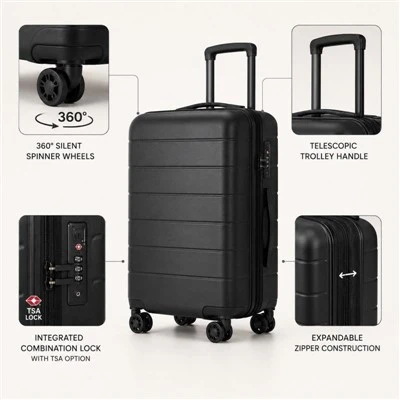
Expandable zipper |
Available |
|
Wheels |
360° spinner wheels, silent wheel option |
|
Trolley |
Iron or aluminum trolley options |
|
Lock |
Regular lock, TSA lock available on request |
|
Interior |
X strap, zipper divider, mesh pocket, wet/dry section |
|
Color |
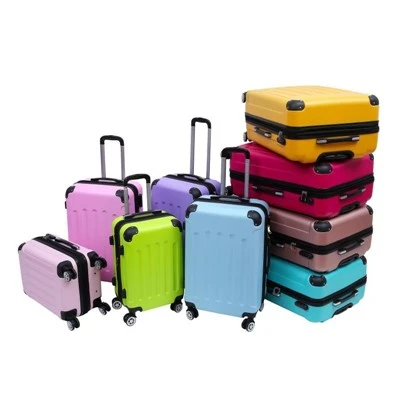
Multiple color options available |
|
Packaging |
Standard export carton packaging |
|
OEM/ODM |
Logo, color, size, and packaging customization supported |
Bulk Order Details
|
Item |
Reference Information |
|
MOQ |
200 sets per style for existing molds |
|
Sample time |
Within 10 days |
|
Bulk production time |
Around 40 days after details are confirmed |
|
Production capacity |
2 production lines, monthly capacity around 30 high containers |
|
Sales model |
Retail, wholesale, OEM, and ODM supported |
|
Target markets |
United States, Europe, South America, Middle East, Africa |
|
After-sales support |
Parts, inspection, and after-sales service supported |
Importer Tip: Don't Judge Durability by Material Name Alone
One of the biggest mistakes in hardside luggage sourcing is assuming the material name means durability.
For example, two suitcases may both be made of ABS+PC, but their performance may vary depending on shell thickness, mold design, corner structure, wheel base reinforcement, trolley quality and QC requirements.
Importers should always compare before bulk buying:
Materials
Thickness of shell
Weight of Shell
Corner construction
Design of wheel base
Outcome of a drop test
Wheel test outcome
Low temperature effect necessity
Packaging strategy
Sales After Parts Support
A slightly cheaper suitcase could end up costing more in the long run if it leads to more customer complaints, product returns or replacement parts.
FAQ: Why does my hard side suitcase crack?
Why the corners of hardside suitcases crack
Corners are high traffic areas. The corners take the brunt of the force when luggage is dropped, stacked or thrown during transport. The sharper the corner design, the thinner the shell or the less reinforcement, the more likely cracks will appear.
Why do the wheels have cracks around them?
The wheel area carries the weight of the suitcase and the constant vibration while rolling. If the wheel base is not properly reinforced, the stress can build up around the mounting points and cause cracks.
Is ABS luggage easy to crack
ABS is a very common material for hard side luggage and is usually used for budget products. But durability is more than the name of a material. Shell thickness, structure, corner design, QC testing, all affect the final performance.
Is ABS+PC better than ABS?
The formulation and structure show that ABS+PC can be positioned for higher durability than basic ABS. However, before buying in bulk, importers should still check the shell thickness, weight, wheel base design and test results.
What to test before wholesale hardside luggage orders?
If the product is to be sold in cold markets, importers should be aware of drop testing, loaded wheel testing, trolley testing and low temperature impact testing.
Yes, we can customize hardside luggage for private label brands.
Yes. OEM/ODM customization can be logo , color , size , packaging according to buyer's requirement .
CTA: Get your Hardside Luggage Durability Checklist!
Thinking of importing hardside luggage in bulk?
Download the Hardside Luggage Durability Checklist to assess shell material, corner structure, wheel base strength, trolley quality, packaging and QC tests before confirming your order.
Wholesale, OEM or ODM Hardside Luggage Projects. Contact us for material options, sample info, testing info and a customized quote.