Lightweight Hardside Luggage for Bulk Buyers: How Light Is Too Light?
"Lightweight" is one of the most attractive selling points in the hardside luggage market for luggage importers.
Consumers want a suitcase that's easy to lift, easy to maneuver, and friendly to airline baggage limits. Business travelers want to move through airports quickly. Families want to keep the extra pounds off. Weight is a spec that e-commerce shoppers will often look at before many other specs.
But the question for bulk buyers is:
How light is too light?
A heavy suitcase may fail to find customers. But a suitcase that is too light may bring another problem: thin shell, weak corners, unstable trolley handle, poor wheel load performance and higher after-sales complaints.
Importers are not seeking the lightest luggage they can find. The objective is to select a balanced lightweight hardside luggage design that satisfies durability, structure and market positioning requirements.
Why Is Luggage Weight So Important For Customers?
Weight is important because travelers feel it instantly.
It's easier to hoist a light suitcase into a trunk, up a flight of stairs, onto a rack in a hotel or train station, or through an airport. With air travel, the weight of luggage also determines how much the traveler can pack before reaching airline baggage limits.
Weight is even more critical for business travellers. Business trips are often short, quick and on the move. The user may carry a laptop, documents, clothes, chargers and personal items. A lightweight suitcase reduces physical burden and makes the overall traveling experience smoother.
Lightweight hardside luggage can support several strong selling points for bulk buyers:
easier for the traveler
Better for short business trips
More attractive for e-commerce product pages
Carry on and checked luggage set suitable
Useful for the family, student, business and general travel market
More keyword potential for searches like "lightweight luggage"
But the term "lightweight" has to be backed up by real product specifications. Provide a straightforward breakdown of suitcase weight according to size for B2B buyers, avoiding marketing fluff.
The Danger of Making Hardside Luggage Too Light
Light suitcases don't necessarily mean a better suitcase. If the weight reduction is not performed in the right way, the product can become less durable.
Main risks for importers are thin shell, weak corner protection, unstable trolley structure and reduced wheel load performance.
1. Risk of a Thin Shell
If the shell is too thin just to save weight the suitcase may look nice in photos but work badly in real use.
A thin shell can cause:
More easily deformed
Poor impact resistance.
more conspicuous stress marks
Corner performance (lower)
Higher risk with drop testing
More complaints of rough treatment
This applies especially for checked luggage. A 24 inch or 28 inch suitcase can hold heavier loads and will take more impact during travel. A shell that is too light and not structurally optimized may not be suitable for long term use.
2. Weakness in Corner Risk
Hardside luggage corners are high-stress zones. Corners can hit stairs, curbs, airport floors, car trunks and baggage handling systems during travel.
If you do not take into account corner strength when reducing weight, you may have problems with the suitcase such as:
Cracks in the corner area
Deformation on wheel areas
Shell edge stress
Damage Drop testing
Higher after sales claims
For bulk buyers, check corner strength, as well as shell material and product structure.
3. Risk of Unstable Trolley Handle
Even a light suitcase needs a strong trolley handle.
If the trolley system is too light or not well fitted, customers might feel shaking when pulling the suitcase. This can make the product feel cheap even if the shell design looks high-end.
Common problems with the trolley handle are
Shake Handle
Bad height adjustment
Movement free
Locking is bad
Unsteady pulling sensation
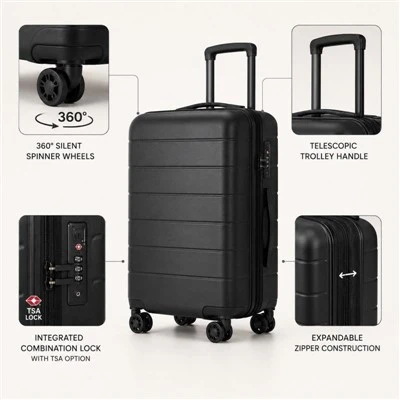
Our hardside luggage can be manufactured with iron or aluminum trolley handles. Three-section trolley handle can handle 20 inch luggage. Two section trolley handles that can be used for 24 inch and 28 inch luggage.
For buyers developing a light weight series the choice of trolley handle should be in line with the target price, product size and positioning.
How to achieve a sensible light-weight design
A good lightweight suitcase is not just about using less material. It should be planned with the right mix of material, of shell structure, of trolley system, of wheels and quality control.
1. Material Selection: ABS, ABS+PC or PP.
Material choice has immediate consequences for weight, durability, cost and market positioning.
We can produce our hardside luggage from ABS, ABS+PC and PP. Buyers should select the material that best suits their market, price point and durability needs.
ABS Hard Side Luggage
ABS is often used for low-cost luggage programs. It can be OK for buyers that are concerned with price competitiveness, promotional channels, wholesale programs or entry level retail products.
But if the product is presented as lightweight and durable, buyers should pay attention to the thickness of the shell, the strength of the corners and the test results.
ABS+PC hard shell luggage
ABS+PC could be a more balanced option for buyers looking for better appearance and improved performance over basic entry level models.
For importers focused on the mid-range e-commerce, retail or private-label sectors, ABS+PC offers a practical material selection.
PP Hard Sided Suitcase
PP is a good option for buyers looking for a lightweight and flexible hardside luggage option. It may be a good fit for buyers looking to develop a lighter product line with the practical durability.
Before mass production, importers should verify the real weight of the sample, the shell structure, the test results and the final cost of each material.
2. Optimizing the Shell Structure
Reasonable lightweight design should be derived from structure optimization, not just material reduction.
For example, buyers can discuss with the factory the optimization of the shell structure to reduce unnecessary weight but retain strength in critical stress areas.
Some important areas include:
Corners
Wheelbase zone
Edges on the Side
Connection region handle
Secure area
Zipper or expandible section
Front/rear shell balance
For lightweight hardside luggage, shoppers should ask not just, "How many kilos is it?They should also be asking "Where is the weight saving?"
3. Honeycomb or Reinforced Rib Design – What Buyers Should Confirm
Some light-weight luggage designs may utilize structural reinforcement concepts such as honeycomb texture or reinforced ribs. These designs, if properly engineered, may help to distribute stresses and increase shell rigidity.
But importers should not assume that all lightweight suitcases have this structural design.
Buyers should verify with the supplier before using these claims on product pages:
Is it honeycomb structure really
Whether or not reinforced ribs are present
Which areas of the shell are reinforced
Whether the structure has been tested or not
Design visible or internal
Whether it is the look, the capacity, or the price
If the structure is not confirmed, don't say it as a product selling point.
4. Lightweight Trolley Handles
Another important aspect in the design of lightweight luggage is the trolley handle.
A lighter trolley handle will reduce total product weight but it still has to be stable enough for real travel use. Buyers should test for weight, strength, control of shaking, and ease of pulling.
Hard side luggage can be made with iron trolley handles or aluminum trolley handles. The 20 inch size can have a 3 section trolley handle. The 24 inch and 28 inch sizes can have 2 section trolley handles.
B2B buyers: The trolley system needs to be tested in combination with the full suitcase and not simply evaluated as a standalone component.
Reference Weight by Size 20 / 24 / 28 Inch
Light luggage. The weight by suitcase size must be listed clearly.
The net weights we currently refer to are:
|
Size |
Reference Net Weight |
|
20 inch |
2.8 kg |
|
24 inch |
3.5 kg |
|
28 inch |
4.5 kg |
These weights can help buyers develop a clear product specification sheet for wholesale, retail, e-commerce or OEM/ODM projects.
For importers, it's not just the attractiveness of the weight. The question is whether the luggage still passes the quality checks required at this weight.
How Light Is Too Light?
If the reduced weight causes visible or functional problems, a suitcase may be too light.
If buyers notice they need to be cautious:
Shell too thin
Corners are soft
hand on trolley is too shaky
Wheels are unstable under load
Wheel base area seems weak
Shell is easy to deform under pressure
Weak Drop Test Result
The supplier cannot explain the source of the weight reduction
A good lightweight suitcase should feel steady even when packed, rolled, lifted and tested.
Bulk Buyer Inspection Form
Inspect the product from several angles before confirming a lightweight hardside luggage order.
1. Weight Inspection
Net weight actual check. By size.
Verify:
Net weight 20 inch
Net Weight 24 inches
28 in net wt
including weight of wheels, handle, lock, zipper and full interior
If the weight of the sample is equal to the final weight of the production
Is the weight on the product page right
B2B buyers should not guess at weight. It is to be measured and recorded in product specification sheet.
2. Drop Tests
Light baggage must resist the shock of travel, so drop testing is important.
Verify:
whether drop testing is done as part of quality control
Whether corners are stable after testing
If wheel base areas are cracked
If the shell is going to deform
Whether the zipper, lock, and handle are still working
Our quality control can include: drop testing, wheel testing, trolley testing. Importers use these tests to decide if the light weight design is suitable for bulk orders.
3. Shaking the Trolley Handle
After assembly, test the trolley handle.
Check.
Pulling smoothness
height adjustable
Shaking table
Lock Function
Load stability management
Difference between 20 inch, 24 inch & 28 inch sizes
A light suitcase with a wonky trolley handle can make for a bad customer experience, especially for business travelers.
4. Performance of Wheel Loads
Strong wheels are needed for even light luggage.
Our hardside luggage has 360° spinner wheels and a quiet wheel design. This is a key attribute of hard shell luggage especially for the business and travel markets.
Buyers should inspect:
Smooth running
Wheel noise
Wheel Shake
Strength of wheel base
Running under load
Changes in direction
Availability of spare parts
In larger sizes the performance under wheel load is more important because the suitcase may carry more weight.
5. Shell and Corner Strength
"A light shell shouldn't feel flimsy.
Review: 4.
Shell thickness sense
corner stiffness
Pressure / Resistance
Strengthened zones
base link wheel
Connector, side handle
Zipper Area, Expandable
All our hardside luggage styles can be made with expandable construction. For expandable luggage, this option should be checked carefully if customers choose this option as the expandable zipper can affect the capacity, weight, and stability of the shell.
B2B Selection Advice: What Channels are Appropriate?
Lightweight hardside luggage is available on a few B2B channels.
E-Commerce Company
Online shoppers tend to compare weight, size, material, color, and price. Clear weight data for more trust on product pages and less confusion.
Travel Channels Business
Business travelers on short trips often prefer lighter luggage. The 20 inch lightweight hardside suitcase can be positioned for business trips, weekend travel and digital work life styles.
Wholesale and Retail Purchasers
Lightweight luggage offers a practical, easy-to-use product line for wholesale and retail buyers, catering to general travelers, students, families and business users.
Corporate & Gift Channels
Lightweight luggage can also be effective for corporate gift programs if the design, color, logo and packaging are properly customized.
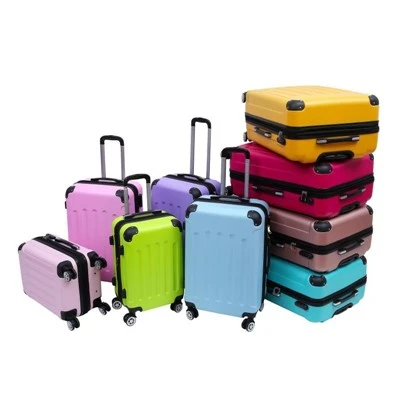
OEM/ODM service for our luggage is available, such as logo, color, size and packaging. The available color options can be beige gold, bright red, green, yellow, dark blue, pink, army green, gray and other customized options depending on order requirements.
What Should a Lightweight Series Spec Sheet Contain?
What to Include in a Professional Lightweight Luggage Spec Sheet
|
Specification Item |
What to Include |
|
Material |
ABS, ABS+PC, or PP |
|
Size |
20 inch, 24 inch, 28 inch, or three-piece set |
|
Net Weight |
2.8 kg / 3.5 kg / 4.5 kg reference weights |
|
Wheel |
360° spinner wheels, silent wheel design |
|
Trolley Handle |
Iron or aluminum trolley handle |
|
Lock |
Regular lock; TSA lock available for special requirements |
|
Interior |
X strap, zipper divider, mesh pocket, wet/dry section |
|
Expandable Design |
Available |
|
Color |
Standard or customized color options |
|
Packaging |
Regular export carton packaging |
|
MOQ |
200 sets per style for existing molds |
|
Sample Time |
Within 10 days |
|
Bulk Production Time |
Around 40 days after details are confirmed |
|
Quality Control |
Factory inspection, drop test, wheel test, trolley test |
|
After-Sales Support |
Accessories, quality inspection, after-sales service |
This type of spec sheet helps importers to compare products better and gives distributors a clearer picture of products for sales.
Bulk Buyers FAQ: Lightweight Hardside Luggage
What is a good weight for a lightweight hardside suitcase?
The weight of a good suitcase depends on its size, construction and material. The present reference net weight are 2.8 kg for 20 inch, 3.5 kg for 24 inch, 4.5 kg for 28 inch.
Lighter Luggage: Is it Always Better?
Nope. The light luggage may have a thin shell, weak corners, unstable trolley handle and poor wheel load performance. Importers need to balance weight with durability.
What material is good for hard case luggage that is lightweight?
ABS, ABS+PC, and PP can all be used depending on the target market and price level. Buyers should check the actual sample weight, shell performance and test results before mass production.
Can you have expandable capacity in lightweight luggage?
Yeah. Our hardside luggage styles can be constructed with expandable structure. Buyers should consider the impact of the expandable design on the weight, capacity, and shell stability.
What Tests Should Importers Demand?
Importers should ask for weight checking, drop testing, wheel testing, trolley testing and final factory inspection. These checks help in verifying if the lightweight design is reliable for bulk orders.
Can you customize hardside light luggage?
Yes. OEM/ODM customization can be LOGO, Color, Size, and Packaging. Buyers can produce lightweight luggage for e-commerce, wholesale, retail, business travel, or gift channels.
Final Purchase Advice
Weight is never the sole factor when it comes to lightweight hardside luggage, especially for bulk buyers.
A strong lightweight luggage program should include:
Net wt.
Shell materials
Shell construction
Cornering power
Stability of trolley handle
Performance on wheel load
Design is scalable
Quality Tests
After-sales service
The lightest suitcase is not the one with the lowest number on the scale. This is the one that glides easily, feels light, passes quality control and minimizes customer complaints.
We can make our lightweight hardside luggage series with ABS, ABS+PC or PP material, 20/24/28 sizes, 360° silent spinner wheels, expandable structure, OEM/ODM customization and quality control support.
Call to action
In search of a lightweight hardside luggage series for your market?
We can provide you with a lightweight series spec sheet upon request, which includes material options, size details, reference net weight, wheel configuration, trolley handle options, packaging information, MOQ, sample time, and bulk production lead time.