Carry-On Baggage Size Guide for Retailers: How to Avoid Complaints About Oversized Items
Why the Size of Carry-On Luggage Causes Problems for Retailers
Size-related complaints are among the most common reasons customers request returns or leave negative reviews for luggage retailers and importers.
Sometimes a suitcase is advertised as a "20 inch carry-on luggage", but the passenger may still have problems at the airport. This is because airlines usually measure the complete external dimensions, and not only the suitcase shell.
Some common complaints from customers are:
"The airline told me my carry-on was too big. The size description did not include the wheels."
"The suitcase fits the description on the website but failed at the boarding gate. I had to pay extra for baggage because my luggage exceeded the limit."
Retailers face issues with vague size information:
Unnecessary returns
Negative customer feedback
Higher after-sales costs
Customer confidence lost
So luggage suppliers should not only provide "20 inch / 24 inch / 28 inch" on their products. They need to have a clear definition of the real product dimension and measurement methods.
1. Why Travelers Should Care About Carry-On Restrictions
The biggest concern for passengers is not the suitcase itself, but whether the suitcase will pass the airline inspection.
Airlines normally check:
Height
Width
Depth
Wheels
Controls
Outside parts
A suitcase that appears small in a photo may test the limits when wheels and handles are factored in.
That is especially true of:
Frequent flyers
Travelers from abroad
Low-cost airline passengers
Customers buying luggage online without seeing the product first
For retailers, this means product pages need to answer one simple question:
"Does this luggage fulfill the customer's travel requirement?"
2. Product Size vs. Overall Size: What Is the Difference?
One of the biggest mistakes in luggage listings is to confuse case size with overall dimensions.
Product Size (Shell Size)
Usually product size refers to the suitcase body measurement.
For example:
20 inch suitcase
24 inch luggage
28" travel bag
This measurement usually only refers to the suitcase shell.
Not necessarily comprising:
Wheels
Control
Side foot
External add-ons
Overall Dimensions (With Wheels and Handles)
Overall dimensions are the complete suitcase measurements.
A good B2B product specification should include a clear statement of:
Overall size = Shell + Wheels + Handles + External parts
This helps retailers avoid misleading customers and reduces complaints after purchase.
It is highly recommended that importers ask suppliers for the overall dimensions before placing bulk orders.
3. Different Markets' Standard Sizes of Carry-On Luggage
Luggage sizing varies by market.
Retailers should not think that one size fits all.
US Domestic Market
US customers are generally interested in:
Carry-on compatibility
Lightweight design
Maximum space for packing
Popular product positioning:
Small carry-on luggage
Lightweight hard shell luggage
Business travel bag
European Market
European customers are typically more sensitive to:
Strict limits on airline size
Dimensions of cabin luggage
Lightweight construction
The measurement information should be clear because many European airlines have strict rules about cabin baggage.
Asian Markets
Asian travelers like:
Compact luggage size
Light materials
Storage design (practical)
If you're a retailer selling to Asia, a clear size chart will help your customers easily compare the options.
Budget Airlines Industry
For customers of budget airlines, size is usually the biggest concern.
They concentrate on:
Precise dimensions
Expandable form factor
Controlling weight
Accurate specifications should be provided by the luggage vendor before purchase.
4. How B2B Retailers Should Show Luggage Dimensions
A professional luggage product page requires more than just:
"20 inch carry-on luggage"
The full specification table should contain:
1. Size of Product
It's an instance of:
20 inch
24 inch
28"
These are typical market categories.
These standard sizes are supported by the factory.
2. Size of Packing
Packing size is important for:
Warehouse planning
Container loading
Calculation of freight costs
Standard carton data should be provided clearly for export packaging.
The supplier supports regular export carton packaging including three-piece set carton size information.
3. Total Dimensions with Wheels
This is one of the most critical specifications for online retail.
The product page should clearly differentiate between:
This prevents customer confusion.
|
Measurement Type |
Meaning |
|
Case Size |
Shell measurement |
|
Overall Size |
Including wheels and handles |
|
Packing Size |
Export carton measurement |
4. Litre Capacity
Customers buy more than dimensions.
They purchase:
How many clothes will fit
If it is also for business travel
If it is family travel friendly
Capacity information should be provided by retailers whenever possible.
5. Don't Judge Luggage by "20 Inch"
Many buyers only focus on:
"Is this a 20-inch bag?"
But professional buying decisions should consider:
1. Real External Dimensions
A 20 inch suitcase from different factories can have different:
Thickness of shell
Wheel structure
Design handling
Usable space
2. Selection of Materials
Different materials determine the positioning of products.
The available material options are:
ABS
ABS+PC material
PP
Each material can be positioned differently in the market and priced accordingly.
3. Mass
The fact that it's lightweight is a huge selling point.
Weight reference available:
|
Size |
Approximate Weight |
|
20 inch |
2.8 kg |
|
24 inch |
3.5 kg |
|
28 inch |
4.5 kg |
4. Scalability
Expandable luggage offers more flexibility.
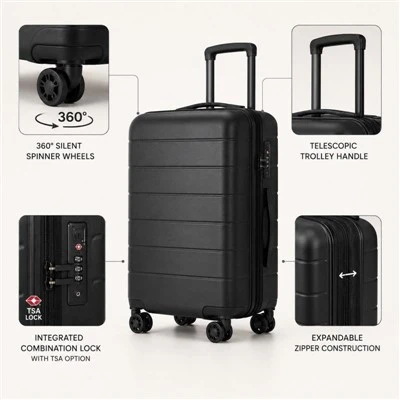
The factory supports the design of extendable zippers for luggage products.
6. What Features Should Retailers Look for Besides Size
Whether it can travel depends on the luggage size.
But it is the quality of the product that brings customers back.
A professional hard shell luggage specification could be:
360° Spinner Wheels
Smooth mobility is important for customer experience.
The products support:
360° spinner wheels
Silent type wheel design
Interior Organization
Customers demand real storage:
Straps in the shape of an X
Compartment with zip
Pockets with mesh
Such features allow for packing convenience.
Options to Handle
Markets may require different handle configurations.
Options might include:
Iron handle bar
Aluminum handle
Size options:
20 inch 3-section handle
24/28 inches: two-part handle
7. Carry-On Luggage B2B Buyer's Checklist for Bulk Ordering
Before making a wholesale order, retailers should check:
Dimension Checklist ✓
Shell dimensions
Overall dimensions with wheels
Handle height
Packing dimensions
Carton dimensions
Product Specification Checklist ✓
Choice of materials
Weight
Expansion feature
Wheel design
Lock type
Interior organization
Supplier Capability Checklist
A good luggage supplier should offer:
✓ OEM/ODM service
✓ Logo customized
✓ Color customized
✓ Size customized
✓ Packaging customized
OEM/ODM service and multiple product customization options are available from the supplier.
8. It Is Important To Work With A Professional Luggage Manufacturer
It's not just the purchase of a suitcase for retailers.
The aim is reduction:
Customer complaints
Return rates
Risks to quality
A professional supplier should know:
Various market needs
Issues with airline size
Expectations of retail customers
Product positioning
The factory accepts wholesale, retail, and OEM/ODM cooperation, with existing molds and MOQ of 200 sets per style.
Production Capacity:
Two manufacturing lines
Approximately 30 high-cube containers per month
Conclusion: Good Size Information Drives More Luggage Sales
To avoid complaints of oversized baggage, luggage retailers must begin with correct product information.
A professional carry-on luggage list should include:
Size of product
Total measurements
Material
Weight
Capacity
Functions
Wheel design that can be expanded
Don't just say "20 inch" and sell suitcase.
Sell it by stating:
Precise dimensions + practical application + dependable manufacturing capacity.
This helps build customer trust for retailers and reduces after-sale problems.
Looking for a Carry-On Luggage Size Solution for Your Market?
What We Offer:
US / Europe / global market size evolution
OEM & ODM luggage customization
Material selection support
Color and packaging customization
Wholesale hard shell luggage solutions
Get in touch to develop suitable luggage sizes for your target customers.